

Description
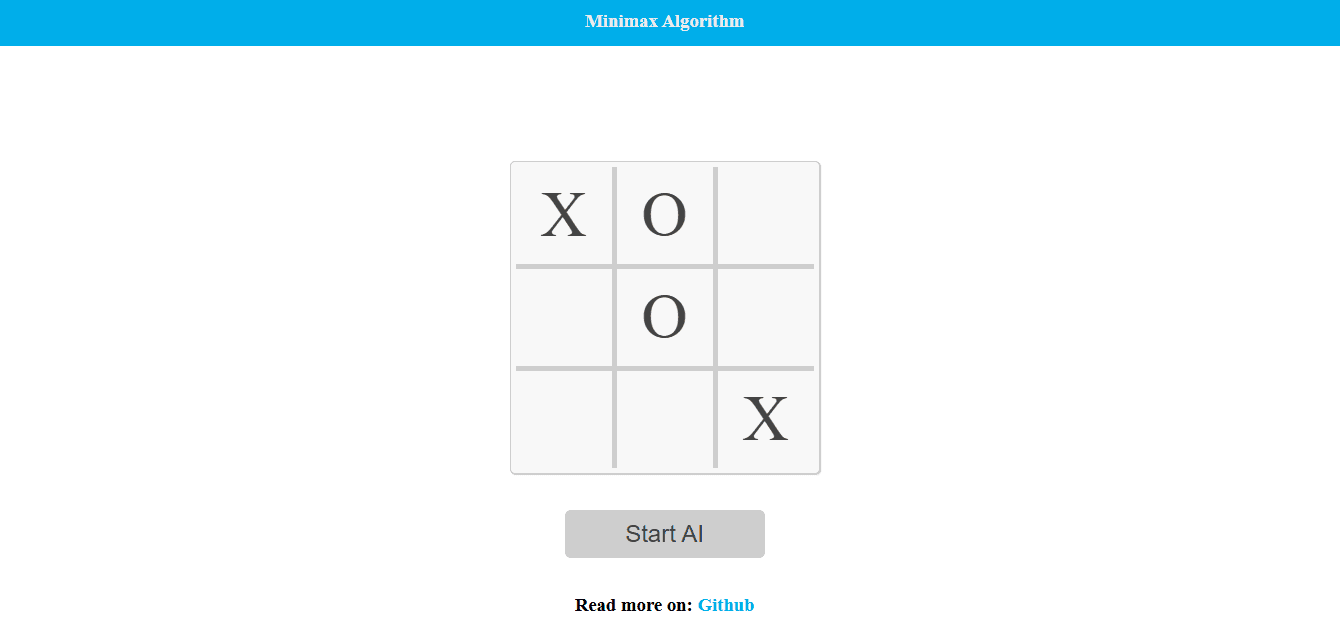
To solve games using AI, we will introduce the concept of a game tree followed by minimax algorithm. The different states of the game are represented by nodes in the game tree, very similar to the above planning problems. The idea is just slightly different. In the game tree, the nodes are arranged in levels that correspond to each player’s turns in the game so that the “root” node of the tree (usually depicted at the top of the diagram) is the beginning position in the game. In tic-tac-toe, this would be the empty grid with no Xs or Os played yet. Under root, on the second level, there are the possible states that can result from the first player’s moves, be it X or O. We call these nodes the “children” of the root node.
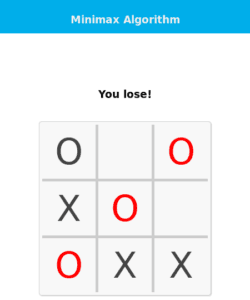
The algorithm was studied by the book Algorithms in a Nutshell (George Heineman; Gary Pollice; Stanley Selkow, 2009). Pseudocode (adapted):
minimax(state, depth, player)

	if (player = max) then
		best = [null, -infinity]
	else
		best = [null, +infinity]

	if (depth = 0 or gameover) then
		score = evaluate this state for player
		return [null, score]

	for each valid move m for player in state s do
		execute move m on s
		[move, score] = minimax(s, depth - 1, -player)
		undo move m on s

		if (player = max) then
			if score > best.score then best = [move, score]
		else
			if score < best.score then best = [move, score]

	return best
end
Now we’ll see each part of this pseudocode with Python implementation. The Python implementation is available at this repository. First of all, consider it:
board = [ [0, 0, 0], [0, 0, 0], [0, 0, 0] ]
MAX = +1
MIN = -1
The MAX may be X or O and the MIN may be O or X, whatever. The board is 3×3.
def minimax(state, depth, player):


Reviews
There are no reviews yet.